Amazon Advertising Guide:
What Enterprise Brands Need to Know to Build and Scale Performance

Introduction
Most brands running Amazon ads are not underinvesting in their ad spend. They’re underinvesting in their ad strategy. The campaigns are live, the budgets are allocated, and the dashboards show plenty of activity. But activity isn’t the same thing as architecture.
For enterprise brands competing for market share in highly competitive retail marketing categories, when there’s no real strategy behind the spend, the ad budget stops working for you and starts working against you. In competitive categories where CPCs are high and every placement is contested, that inefficiency shows up directly in profit.
This guide is written for marketing directors and ecommerce leads at brands that already have Amazon advertising in motion. Teams evaluating whether their current setup, whether managed in-house or by an incumbent amazon advertising agency, is actually built for scale. Amazon’s ad platform has matured significantly. The brands winning aren’t simply outspending the competition. They’re running a more sophisticated system.
Here’s what that system looks like.
The Amazon Advertising Ecosystem
Amazon’s ad products are typically presented as a menu. Pick what fits your budget, activate, and measure. But that framing treats interconnected tools as independent options. And running them that way costs you.
The real leverage comes from treating Amazon advertising as a funnel, where each ad type plays a distinct role and coordinates with its counterparts.
Amazon DSP sits at the top of the architecture: programmatic buying at scale, powered by Amazon’s first-party purchase data. Sponsored Brands build awareness and drive consideration in the upper and mid funnel. Sponsored Display extends reach and manages retargeting across the purchase journey. Sponsored Products capture intent at the point of search.
Winning strategies don’t pick from the menu. They run the full system. DSP and Sponsored Brands create the awareness that makes Sponsored Products more efficient. Sponsored Display recaptures what doesn’t convert on first contact. Each layer feeds the next. That compounding effect is what separates brands that grow on Amazon from brands that merely spend on it.
Where Most Amazon Sellers Break Down
The most common failure isn’t a single underperforming ad type. It’s the absence of coordination between them.
Brands run Sponsored Products in isolation and wonder why their efficiency metrics have plateaued. Or they invest in DSP without the organic and self-serve foundation that makes that investment efficient. The funnel collapses because it wasn’t built as one in the first place.
A coherent Amazon Ads strategy requires thinking across all four layers simultaneously: not optimizing each in isolation, not allocating budget by gut instinct, and not inheriting campaign structures that were set up years ago and never revisited.
Sponsored Products: The Competitive Intelligence Layer
At enterprise scale, Sponsored Products stop being a performance tactic and start functioning as a competitive intelligence system.
The core mechanics are well understood: PPC ads appearing in search results and on product detail pages, targeted by keyword or product targeting.
But the strategic value runs deeper than placement. Sponsored Products data tells you how customers search, where competitors are bidding, which of your ASINs are gaining or losing product visibility, and where your share of voice is slowly eroding.
Keyword Architecture Matters More Than Bid Levels
Brands that approach Sponsored Products ads as a bidding exercise miss the structural work that makes bidding efficient. Effective keyword targeting requires isolating match types into discrete campaign structures:
Match Types at a Glance
-

Broad match
Captures the widest range of search terms, useful for discovery and surfacing new keyword opportunities
-

Phrase match
Reaches customers whose search includes your keyword in sequence, balancing reach with relevance
-

Exact match
Targets specific search terms precisely, giving you maximum control over where your ad spend goes
-

Negative keywords
Are equally critical. Regularly auditing search term reports to exclude irrelevant or low-converting terms prevents budget waste and keeps campaigns focused
Fix the Structure First
Without that architecture, you’re funding discovery and conversion from the same pool and can’t cleanly tell which is working.
At enterprise scale, this extends to ASIN-level campaign segmentation. High-velocity hero products don’t belong in the same campaign structure as long-tail SKUs. Mixing them creates budget allocation problems that no automated bid strategy fully compensates for. The algorithm rewards what it’s given. If the structure is flawed, optimization compounds the flaw.
Defensive and Offensive Applications
Amazon Sponsored Ads serve two strategically distinct purposes that require different campaign logic.
Defensive campaigns protect your own product pages from competitor conquest. This is an acute problem for established brands with strong organic rankings. If you’re not running Sponsored Products ads on your own PDPs, competitors are buying that space.
It’s a straightforward tax on brand equity that most large brands accept without questioning it. And as more lookalike brands emerge with increasingly sophisticated marketing teams, the need to defend your own Amazon PDPs is only increasing.
Offensive campaigns pursue share of voice in competitor and category searches. The targeting logic, bid levels, ASIN selection, and creative approach are fundamentally different from defensive activity. Treating them the same dilutes both.
Most enterprise brands need to run both simultaneously, but for different reasons:
- Defensive campaigns protect revenue you’ve already earned, keeping competitors off your product pages and your existing customers within reach
- Offensive campaigns go after customers who don’t know you yet or are actively considering a competitor
The balance between the two depends on your market position. A category leader and a challenger brand are solving fundamentally different problems.

Sponsored Brands: Brand-Building That Converts
Sponsored Brands ads occupy the most visible real estate in search: the top of the page, above every organic result. For brands with strong organic rankings, that positioning reinforces authority. For brands still building recognition on Amazon, it acts as an accelerant.
The format has expanded considerably. Custom image ads, video ads embedded in search results, and brand-linked storefronts have made sponsored brand ads a genuine brand awareness vehicle. When the creative is executed properly, it serves as an above-the-fold brand moment exactly when a customer is searching for what you sell.
How Amazon Measures New Customer Acquisition
One of the most underused measurement capabilities in the Amazon advertising ecosystem is new-to-brand attribution. Amazon defines a new-to-brand purchase as a first-time order from a customer who hasn’t bought from that brand on Amazon in the preceding 12 months.
That matters because a campaign that looks expensive on Advertising Cost of Sales (ACoS) might be doing something more valuable: bringing in customers who have never bought from your brand before. ACoS only measures the immediate revenue from that click. It has no way of accounting for what that customer is worth over time.
Brands that optimize purely for efficiency end up cutting exactly those campaigns. They concentrate ad spend on people already likely to buy, and wonder why the new customer pipeline dries up. They’re harvesting an existing customer base, rather than growing a new one.
Full-Funnel Positioning
Sponsored Brands works best when coordinated with the rest of the advertising architecture.
A customer who encounters a sponsored brand ad in search, clicks through to an Amazon Store, explores the product range, and is later re-engaged through Sponsored Display: that’s a designed customer journey. It doesn’t happen through coincidence or isolated campaign optimization. It happens when creative, audience, and ad product decisions are made in concert.
Elevate your Amazon advertising
Learn how we help enterprise brands connect creative strategy to every part of the Amazon journey.
Sponsored Display: How Amazon Advertising Extends Beyond the Platform
Sponsored Display ads are the self-serve product in Amazon’s suite that extends reach beyond platform search. Where Sponsored Products and Sponsored Brands operate within Amazon’s search environment, Sponsored Display ads reach audiences on product detail pages, across Amazon’s owned properties, and on third-party sites and apps.
On Amazon and Off It
Sponsored Display is one of the Amazon advertising solutions that reaches audiences both on Amazon and across the web:
- On-Amazon placements include product detail pages, search results, and editorial surfaces, keeping your brand visible throughout the purchase journey
- Off-Amazon placements extend to third-party sites and apps through Amazon’s publisher network, maintaining product visibility well beyond the platform itself
That off-Amazon capability matters for brands with longer consideration cycles. A customer who viewed a product detail page but didn’t purchase can be re-engaged while browsing elsewhere, before a competitor gets to them first.
Audience Targeting vs. Contextual Targeting
Sponsored Display ads offer two distinct targeting approaches, and the choice between them depends on where in the funnel you’re focusing.
Audience targeting reaches customers based on their Amazon shopping and browsing behavior: views of your products, purchases in your category, or engagement with competitor listings. This is your retargeting and conquesting lever. It’s precise and intent-rich.
Contextual targeting places display ads adjacent to relevant product pages and categories, a form of upper-funnel reach that doesn’t require audience qualification. Less precise, but broader, with a legitimate role in awareness-building campaigns where the retargeting audience is simply too small to generate meaningful reach.
Running both simultaneously, with discrete budgets and separate ad copy and creative logic, is the right approach for most enterprise brands. Consolidating them loses the diagnostic clarity that separate campaigns provide.
Amazon DSP: When Programmatic Changes the Game
Amazon DSP (Demand-Side Platform) is Amazon’s programmatic advertising platform. Rather than bidding on keywords in a search environment, it uses Amazon’s first-party audience data to buy ad inventory automatically across Amazon-owned properties, streaming platforms, and third-party websites.
The difference from the self-serve products is strategic, not just technical. Sponsored Products, Sponsored Brands, and Sponsored Display reach customers who are already on Amazon, actively searching and shopping. DSP reaches them everywhere else, targeting based on purchase behavior rather than search intent.
DSP isn’t a more powerful version of the self-serve advertising solutions. It does something they can’t do at all.
What DSP Actually Enables
Amazon DSP uses Amazon’s first-party audience data, including purchase history, category affinity, lifestyle segments, and behavioral signals, to serve display ads, video ads, and audio ads to qualified audiences wherever they are. That includes Fire TV, Amazon-owned properties like IMDb, premium publisher inventory, and connected TV environments.
No other demand-side platform has access to actual purchase data at Amazon’s scale. That’s the core value proposition, and it’s a structural advantage that no cookie-based or modeled audience alternative can replicate. Amazon advertising management through DSP means your targeting is grounded in what people actually buy, not just what they browse.
Dynamic bidding within DSP automatically adjusts bids in real time based on conversion likelihood, ensuring ad spend is concentrated on the highest-value opportunities.
The Right Conditions for DSP Investment
DSP investment makes sense under specific conditions:
- Budget: the brand needs sufficient ad spend to justify DSP’s minimum investment requirements. This is not an entry-level product
- Foundation: the self-serve funnel needs to be optimized first. DSP amplifies what’s already working; it doesn’t fix what isn’t
- Measurement: the framework needs to account for DSP’s upper-funnel role, where direct attribution is often indirect and delayed
For enterprise brands with established Amazon sales velocity and a mature self-serve foundation, DSP is where the next meaningful layer of performance lives.
Managed Service vs. Agency-Managed DSP
Amazon offers DSP through a managed service option, where Amazon’s internal team executes directly, and through API-based access for agencies and sophisticated in-house teams. The managed service offers access to Amazon’s internal data and optimization tooling, but it limits creative control and strategic customization.
Agency-managed DSP, when the agency has genuine platform depth and an Amazon advertising management practice built around it, can produce better outcomes because strategy and creative can be aligned with the brand’s broader goals rather than Amazon’s optimization defaults.
Streaming TV and Audio: Channels Worth Watching
Streaming TV Ads appear before and during content on Prime Video and Freevee. For brands pursuing broad reach with the targeting precision of Amazon’s audience data, Streaming TV offers a combination that no linear television buy can replicate.
The inventory is non-skippable and brand-safe, reaching audiences that have become increasingly unavailable through traditional broadcast. As Prime Video continues expanding its ad-supported tier, this channel warrants serious attention from any brand thinking about full-funnel reach.
Audio Ads run on the free tier of Amazon Music, surfacing across Echo devices, Fire TV, and mobile during playback breaks. The ad-supported listener base is substantial, and by definition receptive to advertising. They’ve opted into an ad-supported experience in exchange for free content.
Audio works best as a companion to visual campaigns: reinforcing messaging in screen-free moments, extending reach into Alexa-enabled environments, and maintaining brand presence across an increasingly fragmented listening landscape.
Neither channel replaces the core sponsored ads architecture. Both are legitimate expansion plays for brands that have that foundation dialed in.
Measurement: ACoS, RoAS, and What They Actually Tell You
ACoS (Advertising Cost of Sales) measures ad spend as a percentage of ad-attributed revenue. RoAS (Return on Ad Spend) is its inverse: ad-attributed revenue generated per dollar spent. Both are standard. Both are insufficient as standalone performance indicators.
The Limits of Efficiency Metrics
The problem with optimizing to ACoS or RoAS in isolation is that efficiency and effectiveness are not the same thing.
A campaign with strong ACoS may be capturing existing demand, harvesting customers who would have purchased anyway. A campaign with weaker ACoS may be building new-to-brand volume that compounds over time. Amazon PPC management at an enterprise level requires a measurement framework that distinguishes between demand capture and demand creation. Branded Sponsored Products campaigns and competitive category campaigns should not be evaluated against the same efficiency standards.
Tracking click-through rate (CTR) and conversion rate alongside ACoS adds important diagnostic clarity, revealing whether underperformance is a targeting problem, a creative problem, or a product page problem, each of which requires a different response.
Total Advertising Cost of Sales
TACoS, which divides total ad spend by total Amazon revenue rather than just ad-attributed revenue, offers a more complete picture for brands with significant organic sales velocity. As brand strength grows and organic rankings improve, the proportion of revenue requiring paid activation should decrease. Tracking TACoS over time captures that efficiency improvement; ACoS alone cannot.
For brands scaling rapidly, TACoS also surfaces the hidden cost of growth: the paid investment required to establish organic visibility in new categories or geographies. That context matters when evaluating whether a period of elevated ad spend is a problem or a deliberate investment.
Attribution Across the Funnel
Attribution is where Amazon advertising measurement gets genuinely complicated.
DSP and Sponsored Brands campaigns at the top of the funnel contribute to conversions that Sponsored Products ultimately receives credit for. Amazon’s default attribution model assigns credit to the last ad clicked before a purchase, which systematically undervalues anything that ran earlier in the customer journey.
Brands making budget decisions on that basis alone tend to over-index on Sponsored Products and underinvest in awareness-driving formats. Not because the data tells them to. Because the data they’re looking at is incomplete.
The fix isn’t abandoning ACoS as a metric. It’s using it alongside new-to-brand rates, TACoS, and Brand Lift studies to build a more accurate picture of where Amazon Ads are actually creating value versus where they’re just claiming credit.

What to Look for in an Amazon Advertising Agency
When evaluating an Amazon advertising agency, the most revealing questions aren’t about client names or certifications. They’re about how the agency thinks and operates.
The Creative Difference
Sophisticated marketing teams have the mechanics of Amazon advertising well in hand. Bid logic, campaign structure, keyword architecture. What separates campaigns that build brands from those that simply generate clicks is the quality and coherence of the creative across the entire Amazon ecosystem:
Full-Funnel Advertising
-

Amazon Brand Store Connectivity
Sponsored brand ads and video ads that connect to an Amazon Store built around the same story.
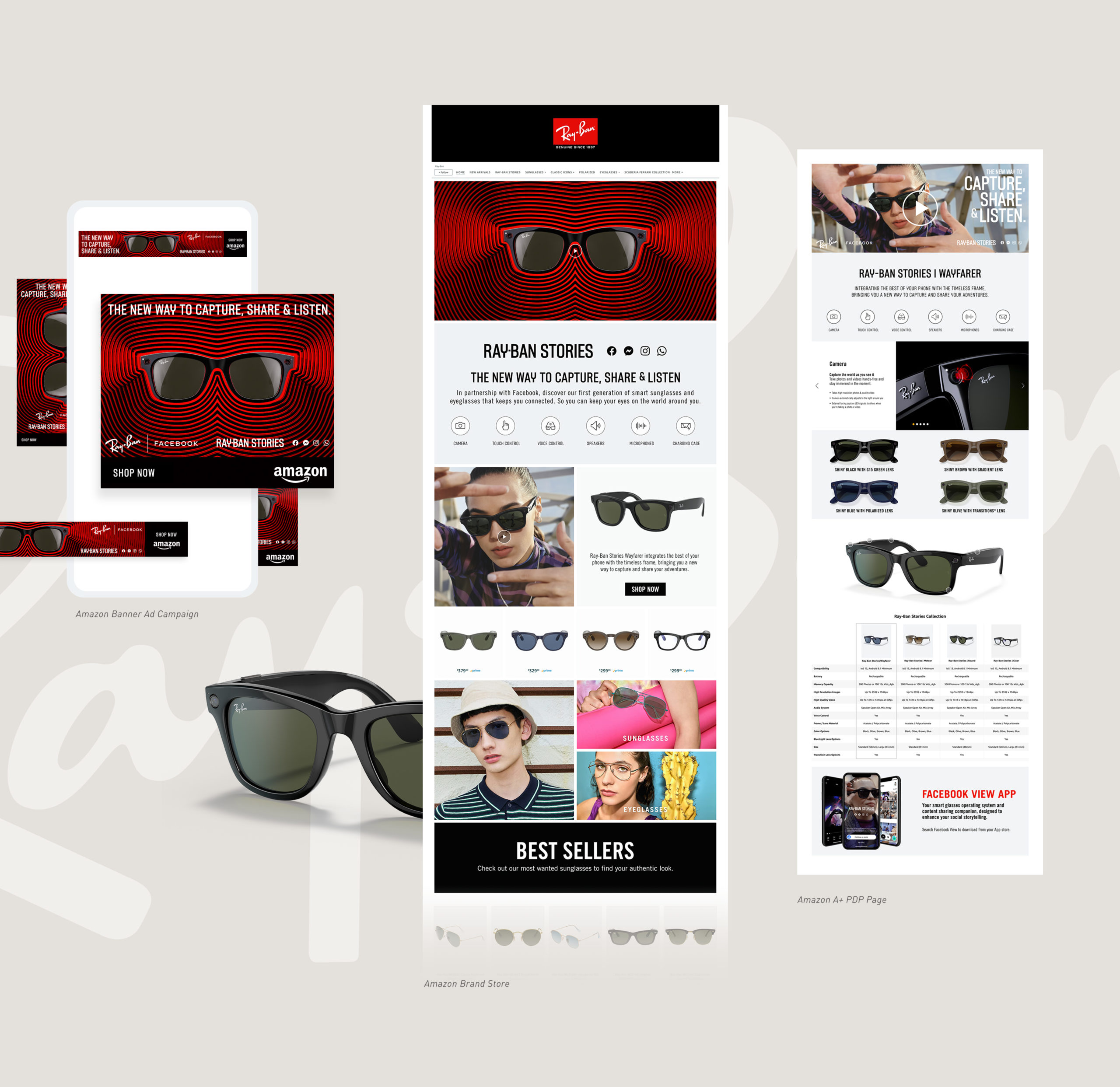
_Further Reading -

Enhanced Product Page Content
A+ Content that converts the customer the ad attracted in the first place, driving them toward a purchase decision.
_Further Reading -

Above the Fold
Imagery and copy that make the value prop immediately clear and drive conversion at first glance.
_Further Reading

Full-Funnel Strategic Thinking
Understanding how the ad types connect strategically matters as much as executing any one of them. The right agency should be able to articulate:
- How DSP activity upstream affects Sponsored Products efficiency downstream
- How sponsored brand ads creative should align with the retargeting audiences Sponsored Display will later reach
That architectural thinking, knowing where each layer fits and how they reinforce each other, is what separates agencies that manage campaigns from agencies that build systems.
Platform Knowledge and Brand Experience
There’s a meaningful difference between producing creative for a global brand with thousands of SKUs and a complex retail ecosystem, and running campaigns for a single-product seller.
Enterprise brands operate with strict brand standards, large catalogs, and retail relationships that require a different level of creative sophistication. The agency you work with should understand that complexity from direct experience, not in theory.
Frequently Asked Questions About Amazon Advertising
What is the difference between Amazon DSP and Sponsored Products?
Sponsored Products are self-serve PPC ads that run within Amazon’s search and product ecosystem, reaching customers who are actively searching on the platform. Amazon DSP is a programmatic platform that uses Amazon’s first-party purchase data to reach audiences across Amazon-owned properties, streaming platforms, and third-party websites — regardless of whether they’re currently shopping. Sponsored Products target based on what people are searching for. DSP targets based on who they are and what they actually buy.
What is ACoS and how should enterprise brands use it?
ACoS (Advertising Cost of Sales) is the ratio of ad spend to ad-attributed revenue, expressed as a percentage. For enterprise brands, ACoS alone is an incomplete measure. It doesn’t account for new customer acquisition value, organic sales contribution, or upper-funnel campaign impact. A more complete framework combines ACoS with TACoS, new-to-brand rates, and Brand Lift studies to build an accurate picture of where ad spend is creating real value.
What are Amazon new-to-brand metrics?
New-to-brand metrics measure purchases by customers who haven’t bought from your brand on Amazon in the preceding 12 months. They matter most when evaluating Sponsored Brands performance, where a campaign’s ACoS may look high while simultaneously driving significant new customer acquisition. That new customer value doesn’t appear in standard efficiency metrics — which is why brands optimizing purely on ACoS routinely underinvest in acquisition without realizing it.
What is TACoS in Amazon advertising?
TACoS (Total Advertising Cost of Sales) divides total ad spend by total Amazon revenue, including both ad-attributed and organic sales. Unlike ACoS, which measures efficiency only against paid revenue, TACoS captures the full relationship between advertising activity and account health. As organic rankings strengthen over time, TACoS should decrease even as ad activity continues — making it a more reliable measure of long-term advertising efficiency than ACoS alone.
When does Amazon DSP make sense for an enterprise brand?
DSP makes sense when three conditions are met: the brand has sufficient budget to meet DSP’s minimum spend requirements, the self-serve campaign structure is already optimized, and the measurement framework can account for upper-funnel attribution. DSP is not a fix for an underperforming Sponsored Products structure. It amplifies what’s already working — and for brands that meet those conditions, it unlocks audience precision that no other programmatic platform can match.
What is the difference between Sponsored Display and Amazon DSP?
Both can reach audiences off Amazon, but they operate differently. Sponsored Display is a self-serve product with auto-generated creative options, reaching audiences through Amazon’s publisher network with relatively straightforward targeting. Amazon DSP is a programmatic platform with access to broader inventory — including streaming TV, connected TV, and premium publishers — and more sophisticated audience data and dynamic bidding capabilities. DSP requires meaningfully higher investment and is better suited to brands with established Amazon sales velocity and a mature self-serve foundation.
What should enterprise brands look for in an Amazon advertising agency?
The most revealing questions are about how the agency thinks, not what they claim. Can they articulate how each advertising layer connects to the others strategically? Do they treat creative as a performance input rather than a production output? Have they worked at the scale and complexity your brand operates at? The agencies that build brands on Amazon understand that creative coherence across the full ecosystem — sponsored ads, A+ Content, Brand Store — is what separates campaigns that convert from campaigns that merely run.
Work With an Amazon Advertising Agency That Operates at This Level
For over a decade, Iron Creative has been producing Amazon advertising creative for enterprise brands including Levi’s, adidas, Fitbit, and Ray-Ban. If you’re looking for a creative partner who understands the Amazon ecosystem as well as they understand brand, we’d like to talk. Explore our Amazon advertising services or reach out directly.
Drop us a line.
Get Started120 2nd St. Floor 3,
San Francisco, CA 94105